AI & technology
AI in research workflow
25 indexed claims · 13 guests · peaked 2025-Q3
Overview
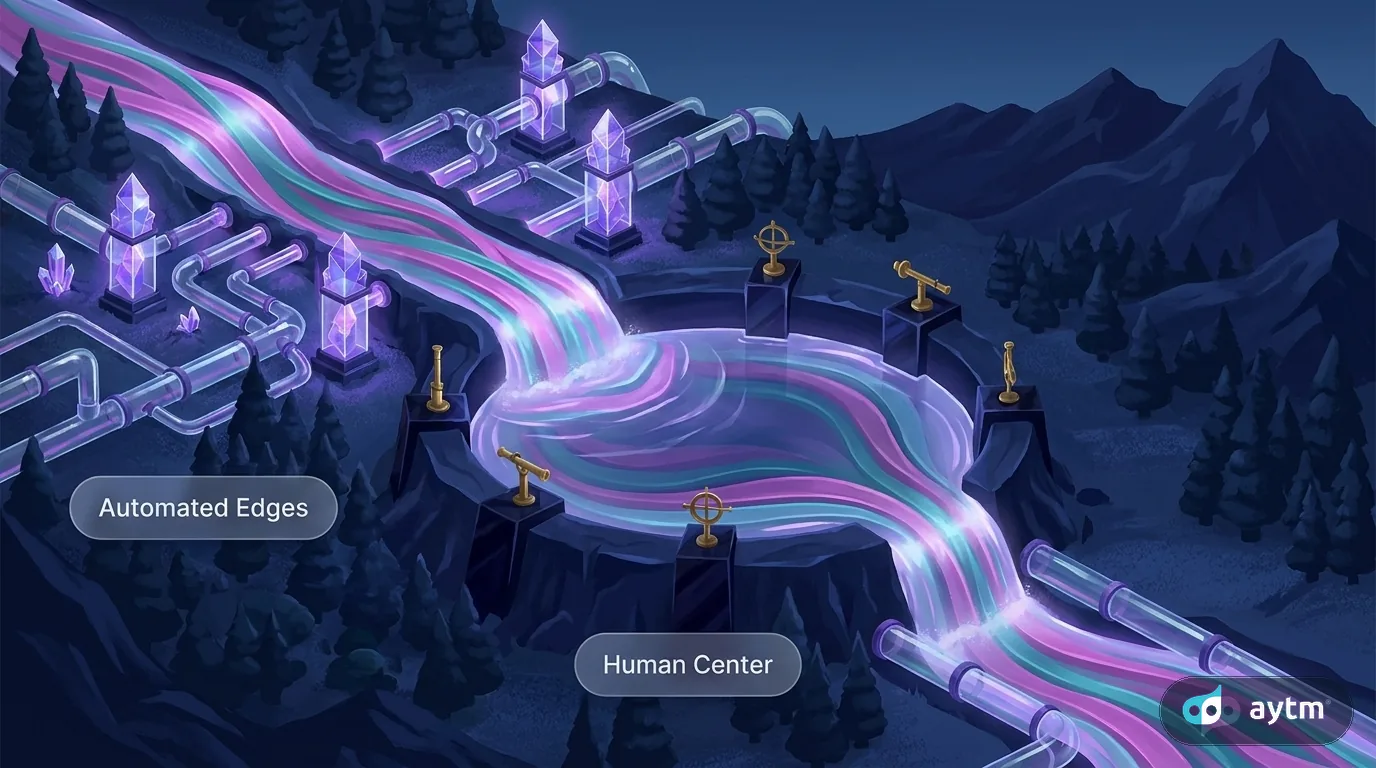
Across these podcast conversations, AI's role in the research workflow has moved from aspiration to daily practice — but the honest accounting is more nuanced than the headlines suggest. The dominant finding is structural: AI reliably automates the middle of the research process (open-end coding, transcript synthesis, first-draft data tables) while leaving the bookends — client relationship-building up front and strategic narrative delivery at the back — largely irreducible to automation. A second, quieter tension runs parallel: whether AI should make existing work faster or enable work that was previously out of reach entirely. Guests from across the industry converge on the same warning — AI is a companion and thinking partner, not an authority; the researcher who loses ownership of their own data loses the only thing AI cannot replicate.
From the corpus
- AI use in research falls along a three-level intervention spectrum: no intervention (client query → automated answer; enables retrospective ROI tracking on tracking studies), moderate intervention (current state — AI gets you almost there on specific business cases), and full engagement (seismic shifts like tariffs or the iPhone where AI has no context and humans must step in). — Dave Ritter, Ep. 16 ·
cl-dave-ritter-015 - Counterintuitively, LLMs excel at querying unstructured data (PDFs, transcripts, open ends) but struggle with structured data; properly querying structured data on the fly is a tremendously harder technical challenge than reading verbatim, and remains the holy grail for the next generation of systems. — Shanon Adams, Ep. 49 ·
cl-50th-004 - AI has not produced compelling use cases in pharma primary research and survey design; NLP-based open-end coding dates to the 1970s, AI-designed surveys miss clinical nuance, and the productivity gains in AI-assisted data categorization still require human supervision of the output. — Shawn McKenna, Ep. 9 ·
cl-shawn-mckenna-008 - AI should not know your customer data better than you do; it is a companion and brainstorming partner, not an authority — researchers must remain the experts on their own data and use AI specifically and precisely, like Amelia Bedelia, to avoid misattributions and errors. — Louisea Hudson, Ep. 15 ·
cl-louisea-hudson-016 - The right use of AI for researchers is to unblock — getting unstuck on a categorization problem, generating starter responses, accelerating secondary research — not to outsource the thinking; the wrong use is plug-and-play homework, and the responses are easy to spot. — Don DeVeaux, Ep. 18 ·
cl-don-deveaux-008 - AI's biggest legitimate wins in research are not in data collection but in pre-fieldwork (literature review, prior-work synthesis) and post-fieldwork (persuasion of stakeholders) — the squeeze is on the bookends, not on the empirical center. — David Evans, Ep. 39 ·
cl-david-evans-006 - Researchers should evaluate every stage of the UX/research workflow — exploration, planning, preparation, recruitment, execution, reporting — and intentionally choose where to leverage AI rather than defaulting to or rejecting it wholesale. — Tanya Pinto, Ep. 5 ·
cl-tanya-pinto-006 - AI is changing insights work in two distinct categories: handling chores (volume tasks like transcript reading and open-end coding that LLMs natively do well), and enabling work that was previously impossible without a team of specialists. — Shanon Adams, Ep. 49 ·
cl-50th-002
Contributing guests
Episodes in AI in research workflow
- aytm 50th Episode — Year-in-Review with Lev Mazin and Shanon Adams — Ep. 49 · Mar 3, 2026
- The psychology of human-centered AI with David Evans — Ep. 39 · Dec 16, 2025
- From Classroom to Boardroom: Don DeVeaux on Training the Next Gen of Researchers — Ep. 18 · Jul 22, 2025
- Anticipating the Future: Dave Ritter on AI, Analytics, and Retail Insights at Walmart — Ep. 16 · Jul 8, 2025
- The art and science of innovation: Why mixed methods drive better results — Ep. 15 · Jul 1, 2025
- The Strategic Heart of Pharma Research with Shawn McKenna — Ep. 9 · May 20, 2025
- Tanya Pinto — Human at the Center: Empathy, AI, and the Researcher's Discernment — Ep. 5 · Apr 15, 2025